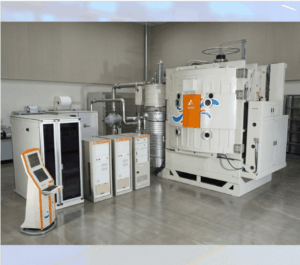
Capital equipment investments commit procurement teams for years. While a PVD coating system quote presents a clear, upfront purchase price covering essential hardware, such as the vacuum chamber, pumping package, deposition sources, and control system, it ignores long-term operational factors. Unaccounted expenses like third-year substrate yield degradation and labor spent recalibrating drifting process parameters quickly undermine that initial quote.
The true cost of ownership reveals itself over thousands of process runs. Capital expenses shift into operating losses through high scrap rates, unplanned vacuum leaks, and missed delivery schedules. For high-reliability aerospace and defense programs, these hidden costs compound exponentially. This guide analyzes how custom-engineered platforms and off-the-shelf systems diverge across their operational lifecycles.
Beyond Capital Expenditure: Quantifying PVD Operational Costs
Capital expenditure represents a small fraction of what a deposition system consumes over its operational lifespan. The remaining expenses accumulate quietly through monthly operating line items like continuous facility power, target consumption, and chamber shield degradation. Routine maintenance labor scales directly with chamber opening frequencies, compounding your baseline expenses.
Extended qualification timelines and scrap rates incur the most significant financial damage. A standard PVD coating system that requires six months of calibration before producing sellable components completely erases its initial price advantage. A minor uniformity variance that rejects just two percent of production creates massive cumulative losses over five years of high-value optics manufacturing. Substrate yield remains the primary lever in any accurate total cost of ownership calculation.
The Hidden Operational Performance Bottlenecks of Standard Platforms
Standard platforms target the middle of the market. Catalog systems serve you well if your components, tolerances, and production volumes match those average specifications. However, defense and photonics applications rarely sit in the middle. When standard equipment encounters specialized requirements, technicians must fill the technical gap with manual interventions that increase your cost per shift.
Common operational friction points include:
- Fixture compromises: Rigid tooling designs force complex geometries into suboptimal positions, degrading thin-film uniformity and forcing smaller batch sizes.
- Recipe babysitting: Deposition sources and plasma assist units that lack proper sizing for your specific material stacks require constant manual tuning during runs.
- Throughput mismatch: Chambers optimized for generic batch volumes force extra process cycles, multiplying total pump-down time and utility consumption.
- Closed control architecture: Proprietary software blocks the advanced data logging and process monitoring that quality teams require for aerospace traceability.
- Single-source spares: Proprietary components unavailable from local distributors convert a minor two-day repair into a multi-week production outage.
Small process inefficiencies add up over time. These combined factors ultimately dictate your actual production cost per acceptable component. For this reason, engineers evaluating a PVD coating system must weigh precise process compatibility as heavily as raw hardware specifications.
Optimising Substrate Yield Through Process-Specific Custom Engineering
A custom system starts from a different design question. Instead of asking what the vacuum chamber can do, engineers ask what your specific component requires. Source geometry, substrate rotation, internal masking, and plasma configurations all adapt to your unique thin-film stack and geometry.
The primary payoff is process repeatability. When film uniformity stems from optimized hardware layouts rather than operator skill, your process stops drifting between shifts. Training cycles shorten, documentation simplifies, and compliance audits become routine-critical advantages in regulated aerospace supply chains.
Custom engineering also protects you against the high cost of manual workarounds. A chamber sized precisely for your production load runs fewer total cycles per month. Fewer cycles mean less mechanical pump wear, lower process gas consumption, and more available manufacturing hours. Dedicated process development support shortens the timeline between system installation and qualified production, ensuring program profitability.

Specialized thin-film applications make this distinction even clearer. For example, depositing hard carbon films for durable optics demands highly specific ion energies and precise reactive gas chemistry. A dedicated DLC coating system delivers these exact conditions natively. Conversely, a general-purpose platform forces you to approximate these parameters, risking coating adhesion and durability.
Structuring a Data-Driven Lifecycle Cost Model for Capital Approval
Strong PVD coating system procurement decisions require a financial model that survives executive scrutiny. Build your projections around operational outcomes rather than individual hardware components.
Track these five critical performance metrics across a realistic five- to ten-year production horizon:
- Cost per accepted part: Track costs by yielded components rather than cost per process run to keep scrap rates visible in every scenario.
- Time to qualified production: Measure the exact calendar weeks from factory delivery to your first sellable production batch.
- System availability: Calculate the actual percentage of scheduled production hours the chamber runs active processes.
- Upgrade headroom: Evaluate how smoothly the system architecture absorbs new deposition sources, diagnostic sensors, or modified recipes.
- Knowledge transfer: Quantify training depth, engineering documentation quality, and vendor technical response times.
This fourth metric warrants targeted engineering focus. Since program goals and technical specs adapt far more rapidly than capital expenditure budgets allow, choosing an open, adaptable system design ensures a seamless retrofit and upgrade path. This proactive approach helps prevent premature capital replacement costs. Tecport Optics embeds this long-term strategy directly into its philosophy, manufacturing turnkey vacuum platforms tailored to your distinct process demands and production scale rather than standard off-the-shelf specs.
Evaluate Your Specific Deposition Lifecycle Economics
At Tecport Optics, we see many engineering teams inherit a deposition platform that creates weekly operational hurdles. The initial specification sheet looks sufficient, but the actual process compatibility fails. Prior to evaluating capital expenditure proposals, we recommend a more direct strategy: provide your thin-film stack specifications, substrate geometry schematics, and projected annual production metrics for review.
Our application engineers map out exactly how a purpose-built vacuum chamber optimizes your final cost per good part. We also state candidly if a standard catalog configuration meets your production requirements more efficiently.
Tecport systems achieve full production-ready status within a single week of facility installation. This rapid deployment significantly reduces qualification delays and improves your long-term ownership economics. Contact our team today to build a precise lifecycle cost model for your next deposition equipment investment.
Frequently Asked Questions
What technical documents are required for a PVD system lifecycle cost analysis?
Request factory acceptance test (FAT) and site acceptance test (SAT) protocols, a recommended spare parts list with lead times, expected consumable intervals, and utility load figures. These four documents provide the data required to build a defensible ownership forecast rather than an estimate.
Are custom PVD systems more difficult to maintain than standard models?
No, provided the manufacturer integrates commercially available subsystems. Look for platforms utilizing industry-standard pumps, gauges, and controllers backed by global service networks. Custom engineering refers to the vacuum configuration and process design, not to exotic, proprietary components.
Why should you perform sample deposition runs on actual substrates before purchase?
Sample runs on your specific part geometries expose thin-film uniformity, stress, and adhesion issues that standard specification sheets cannot predict. These process trials also provide your quality assurance team with empirical baseline data for final acceptance testing.
How does operator training impact the total cost of ownership for deposition equipment?
Training quality directly dictates how quickly your production line reaches consistent, qualified output. Vacuum systems featuring intuitive control software and comprehensive technical documentation reduce operational dependence on a single technician. This knowledge transfer mitigates production risks during staff turnover.