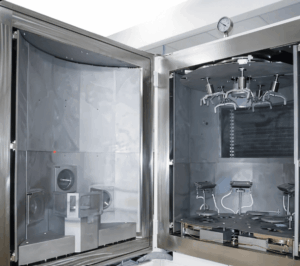
The success of infrared systems depends on the performance of their optical coatings. While materials like germanium and silicon transmit well, they suffer from high reflection losses. Engineered coatings recover this signal and protect substrates from environmental degradation. Meeting strict defense and aerospace standards requires overcoming challenges like high refractive indices and harsh operating conditions, ensuring sensors maintain performance under extreme thermal and environmental stress.
High Refractive Indices and Design Complexities
The physics governing infrared materials complicates the implementation of an efficient optical coating. Germanium exhibits a refractive index of approximately 4.0 within the long-wave infrared spectrum, silicon sits near 3.4, and zinc sulfide measures around 2.2. In comparison, standard fused silica measures roughly 1.45 in visible bands. An uncoated germanium interface reflects over 36% of incident radiation; a two-surface uncoated substrate loses more than half of the total energy budget.
Addressing these reflection losses requires sophisticated anti-reflection designs especially for coverage of wide wavelength pass bands. Material choices and their deposition options in the infrared remain inherently constrained:
- Absorption Limits. Standard oxide materials absorb radiation heavily at wavelengths beyond 5 microns, restricting material selection to specialized fluorides, chalcogenides, and semiconductor compounds.
- Physical Thickness Scaling. IR coatings thickness scales directly with central wavelength and operational band width.
- Stress Accumulation. Thicker film stacks can accumulate severe high mechanical stress introducing a greater vulnerability to environmental stress that can result in micro-fractures or delamination. Run times are proportionally increased.
- Bandwidth Requirements. IR passbands of interest are wide because of the low energy emitted by IR sources. Material index choices and designs are engineered to satisfy the requirements. The wide spectral requirements leave minimal tolerance for thickness errors, as small dimensional deviations compound across complex multilayer designs.
Substrate Preparation and Surface Cleaning
Conventional substrate polishing can leave residual pitch, polishing compounds, and embedded abrasive media on the surface. Furthermore, germanium rapidly forms native oxides that degrade LWIR transmission interface bonding, while soft substrates like zinc selenide scratch easily during manual handling.
Mechanical and solvent cleaning alone cannot remove persistent organic or polishing contaminants. Hydrocarbon monolayers only a few angstroms thick alter surface energy and compromise initial film nucleation. Ultrasonic cleaning removes adherent particulates, yet excessive ultrasonic power risks chipping brittle optic edges.
Engineers rely on in situ surface treatment prior to deposition to establish ideal surface conditioning:
- Gentle Ion Bombardment. Low-energy ion beams strip native oxides and hydrocarbons inside the vacuum chamber without causing surface damage to fragile IR crystals.
- Plasma Surface Conditioning. Cold plasma treatments increase surface energy and generate active bonding sites without mechanical contact or thermal overload.
Adhesion Promotion and Stress Management
Integrating specialized nucleation interlayers resolves mechanical compatibility issues between exotic substrates and functional thin films. A structural optical coating often incorporates a thin seed layer to promote chemical bonding, bridge lattice mismatches and distribute internal forces across the stack.
For example, diamond-like carbon provides exceptional hardness and moisture resistance for exposed exterior optics, but it exhibits severe intrinsic compressive stress. Depositing diamond-like carbon directly onto soft zinc sulfide leads to catastrophic delamination because of the chemical mismatch. Introducing a graded germanium or silicon-based interface layer successfully is necessary to achieve adherence.
Thermal expansion mismatch poses an equally critical challenge. Infrared cryogenic optical systems experience rapid operational temperature fluctuations. A thin-film architecture that passes ambient adhesion tests can craze or buckle under thermal shock. Utilizing plasma-assisted or ion-assisted deposition imparts kinetic energy directly to incoming adatoms, producing dense, amorphous low stress adherent growth structures with reduced moisture absorption and long-term spectral stability.
Deposition Equipment and Process Control
Translating theoretical thin-film designs into repeatable production requires programmable deposition control electronics capable of maintaining tight process stability over extended execution cycles. Achieving uniform deposition across high-curvature optics, such as missile domes or wide-angle lenses, demands precise spatial control and specialized substrate tooling geometry.
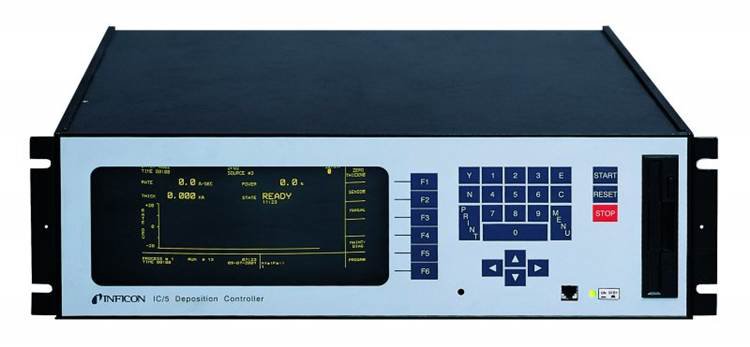
Modern infrared coating platforms require several foundational capabilities:
- Real Time Thickness Monitoring. Thickness measurement and control for IR coatings is done by quartz crystal monitoring. Direct real-time feedback during execution of the coating recipe ensures precise layer termination across thick, multi-layer designs.
- Stable Deposition Rate and Thickness Control. Recipe programming under the direction of the crystal monitor maintains the deposition rate through power control and thickness termination. Minimizes spectral drift and stress accumulation during long physical vapor deposition runs.
- Optimized Chamber Tooling Geometry. Precise source-to-substrate distances, planetary rotation systems, and strategic deposition and ion-assist source positioning guarantee uniform coverage on surfaces having complex geometries.
At Tecport Optics, we engineer thin-film deposition equipment specifically optimized for these challenging infrared requirements. Our deposition systems incorporate plasma-assisted deposition, plasma-enhanced chemical vapor deposition (PECVD), diamond-like carbon capabilities, and ion beam sputtering configurations.
Each platform is tailored to specific substrate geometries, film materials, and throughput targets. Tecport Optics also provides complete process development services, developing procedures, transferring proven infrared coating recipes alongside installed hardware to maximize production yield.
Modernize Your Infrared Production Capabilities
Infrared production programs often encounter unexpected hurdles when moving from design simulation to environmental qualification. When an optical coating fails humidity testing or thermal cycling, the underlying issue rarely stems from the spectral design itself; it typically points to inadequate surface preparation, unmanaged interfacial stress, or inconsistent chamber process control.
Tecport Optics engineering staff has experience in understanding and conquering the optical and durability challenges. Consult with the engineering team at Tecport Optics to evaluate your substrate choices, spectral specifications, and production targets, or visit Tecport Optics online to request a detailed technical proposal for your next optical coating system.
Frequently Asked Questions
How is infrared optical coating performance measured and verified after deposition?
Engineers verify spectral performance using Fourier Transform Infrared (FTIR) spectrophotometry to map absolute transmission and reflection curves. For destructive mechanical and environmental evaluation, representative witness samples coated alongside the main optics during the vacuum run undergo MIL-SPEC testing and performance evaluation.
Can infrared antireflection coatings be uniformly applied to domes and optics with complex geometries?
Yes. Uniformly coating of steep geometries requires highly specialized vacuum chamber configurations like tilted planetary motion or dedicated dome tooling to regulate incidence angles. Thin-film software and process tuning actively compensate for the natural physical thickness falloff that occurs toward the optic's outer edges.
Can a failed diamond-like carbon (DLC) or oxide IR coating be stripped and recoated?
It depends entirely on the film chemistry and substrate properties. Softer oxide stacks can be stripped relatively easily using controlled chemical processing, whereas ultra-hard diamond-like carbon (DLC) films resist chemical removal and typically require mechanical repolishing.