
Every precision optics coating program reaches a pivotal inflection point: the prototype works, the results look promising, and the next logical step is volume production. However, the path from the R & D effort to a production-ready lots is rarely straightforward. Understanding when and how to make this transition in optics manufacturing can mean the difference between a smooth ramp-up and costly delays.
Reading the Optics Manufacturing Signals for Scale-Up
Not every successful R&D result is a signal to scale. Engineers must look for specific indicators before committing to a production transition. Key signs that a process is ready for scale-up include:
- Consistent spectral performance across multiple deposition runs with minimal variation
- Control and stability of all essential process parameters to repeatably function within acceptable performance tolerances
- Yield rates above an acceptable threshold without requiring manual corrections between runs
When R&D meets these conditions, the process becomes mature enough to survive the demands of a larger, higher throughput environment. Attempting to scale before this point often leads to problems that are harder to diagnose in a bigger system.
Designing Repeatable Processes in Optics Manufacturing
Scalability in optics manufacturing begins at the R&D stage, where deposition parameters are systematically exercised with the forward-looking goal of a smooth transition to higher volume production.
A process that depends on an engineer's intuition, subtle manual adjustments, or undocumented "tricks" will not transfer cleanly to a production floor. Instead, the goal during R&D is to define every process parameter with tight tolerances. This includes deposition rates, gas flow ratios, substrate temperature profiles, and tooling factors.
Process control software plays a critical role here. Standardized recipe management systems allow teams to lock in parameters, track deviations, and ensure exact replication of a process across different runs and is independent of operator intervention. When teams digitize and make parameters traceable from the start, scaling becomes an exercise in replication rather than reinvention.
The Chamber Size Gap
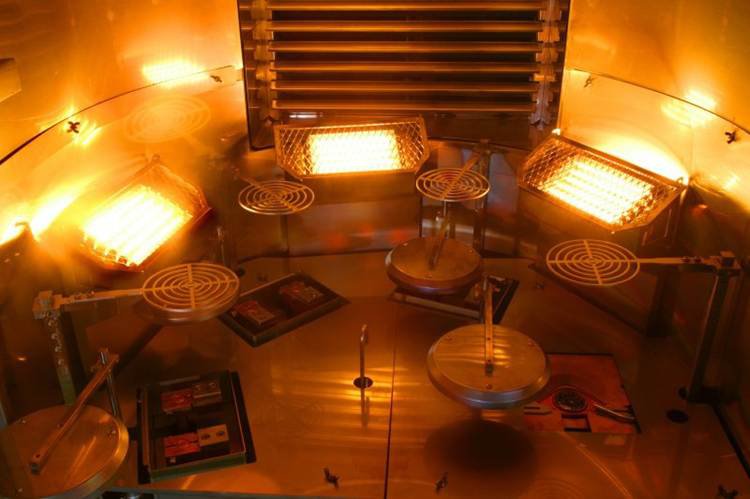
One of the most underestimated challenges in scaling is the transition from a smaller development chamber, such as a 12-inch system, to a large-format production platform. This is not simply a matter of depositing on more parts at once. Larger chambers introduce new variables:
- Flux distribution from evaporation or sputtering sources changes with increased source-to-substrate distances and source locations
- The plasma distribution uniformity of PAD, PECVD and ion sources must accommodate a wider deposition zone.
- Substrate heating must eliminate thermal gradients across larger substrate fixtures to eliminate coating thickness and stress variations not seen in a compact R&D chamber
- Thickness measurement must be appropriately positioned to represent the deposition received by the parts being coated. New tooling factors will be derived.
Each of these factors requires teams to re‑qualify the process. Skipping this requalification step is a common cause of production failures in precision thin film work.
Insuring Coating Process Uniformity in Scaled-up Manufacturing Production
Uniformity is the defining challenge of large-format optics manufacturing. In an R&D chamber, achieving tight uniformity across a small substrate fixture is relatively manageable. In a production system, the stakes are higher.
Several strategies support uniformity at scale:
- Planetary fixture rotation to average out deposition rate variations across the substrate zone
- Optimized source placement and substrate masking to shape flux profiles across the substrate areas
- Crystal and optical monitoring at multiple witness positions to ensure thickness uniformity
- Closed-loop control of deposition rates via quartz crystal monitors or optical monitoring systems
Partner With a System Built for Your Process
The transition from R&D to batch production is where system engineering matters most. An equipment partner who understands both sides of this gap can save engineering teams months of re-qualification work.
Tecport Optics specializes in building custom vacuum coating systems designed to match your requirements from day one. Whether you move from a small development chamber to a large‑format PVD, PAD, or IBS production platform, our team designs the systems to smoothly carry your process recipe into full production without compromise.
Our turnkey approach means your team receives more than just a chamber: you receive a production‑ready, process‑validated system that becomes fully operational within one week of installation.
If you are approaching the scale-up decision for your optics coating program, let's talk about how the right system architecture can make that transition faster and more reliable.