Military, aerospace, medical and mechanical systems and components are exposed to extreme operational environments. They require coating that displays durability and survivability beyond typical materials and deposition processes. Examples include exposure to ultraviolet and infrared radiation, mechanical abrasion, thermal cycling, corrosive atmospheres, and impact from dust, sand, and debris. Traditional optical coatings, while adequate for many civilian applications, often fall short of the rigorous requirements demanded by defense systems. In recent decades, Diamond-Like Carbon (DLC) coating has emerged as a transformative solution for these applications.
Amorphous carbon thin films provide the exceptional hardness and wear resistance of diamond. Diamond-like carbon films are used to create an exceptional protective layer that enhances optical component durability and longevity. By extending the operational lifespan of optical systems, reducing maintenance requirements, and improving optical transmission efficiency, DLC coatings deliver substantial cost benefits and increased system reliability for many applications.
Mechanical and Optical Properties of DLC for Optics
DLC films are valued because a single coating can contribute both mechanical protection and optical function. This is difficult to achieve with many traditional dielectric stacks. In optical use cases, DLC is commonly described as a hard, low-friction surface that resists scratching and corrosion while supporting strong transmission in the mid to long-wave infrared.
Key properties that make DLC invaluable on military and aerospace optics include:
- High hardness and scratch resistance maintain surface quality after handling and exposure.
- Low coefficient of sliding friction reduces scuffing and the occurrence of abrasive damage during cleaning or contact events.
- Chemical and corrosion resistance in wet, salty, or contaminated environments.
- High IR transmission with an IR refractive index around 1.95—making DLC useful as a single-layer AR coating on Ge optics.
For IR substrates with a high refractive index such as Ge and Si, DLC is used as the protective layer on the exposed surface. Additional AR coatings are deposited on internal surfaces to increase transmission. The result is a window with high durability and high transmission, for example, as a Ge window on military vehicles.

Durability, Wear, and Low-Friction Performance in the Field
Wear resistance matters in military and aerospace optics because surface damage directly increases scatter and veiling glare with resulting lower contrast and range performance. DLC is often positioned specifically for harsh, rugged environments, including thermal imaging and other defense applications. This is because it resists scratches and corrosion while keeping IR transmission strong.
Environmental durability should be treated as a testable requirement, not a marketing label. Salt fog and similar exposures are frequently used to validate that a durable coating stack continues to protect the substrate over time. DLC is often discussed as meeting aggressive salt fog expectations in optical coating contexts.
The tribological property of DLC provides resistance to abrasion from blowing sand as encountered in desert deployment. The low friction and high hardness is an advantage on tool surfaces to provide wear resistance and extend usable life.
The biocompatibility of DLC is also advantageous in medical contexts, specifically as applied to replacement mechanical implants.
Production Requirements
Assuring the consistent production of the desirable optical, chemical and mechanical properties that DLC provides requires strict control of the molecular structure growth to deposit diamond-like and not graphitic bonds. Repeatable DLC performance depends on process control and interface engineering. Obtaining good adhesion on substrate materials with low stress is a sensitive issue with DLC processes.
High internal stress and weak adhesion are common failure drivers for hard DLC on some IR substrates. While carbon bonds well with Ge and Si substrate materials, a binding layer is required for other IR substrate materials such as ZnS and ZnSe. Delamination risk increases when stress is not managed at the interface.
System Processes for Repeatable DLC Deposition
Plasma-enhanced methods are common for DLC, and PECVD is widely used in part because it enables film formation at lower temperatures than conventional CVD while supporting plasma-based surface cleaning and mechanically robust layers. Lower temperature capability can be important when coating temperature-sensitive substrates, fixtures, or assemblies. Cold plasma approaches are explicitly positioned to enable deposition below 212°F for heat-limited polymer optics.
Film density and absorption also matter for optical performance. Higher packing density is associated with better film quality and lower absorption or loss in thin film contexts.
Hardware and controls required for consistent DLC deposition include:
- Plasma generation and bias control for stable, repeatable ion energy at the substrate, since film properties can be sensitive to bias conditions.
- In situ surface preparation capability (plasma cleaning or activation) to improve bonding before carbon growth begins.
- Substrate motion and fixturing to achieve uniform thickness on curved or off-axis optical surfaces, since optical performance depends on thickness uniformity.
- Metrology and monitoring strategy to control the deposited thickness.
Advancing Defense Optics With DLC Coating Technology
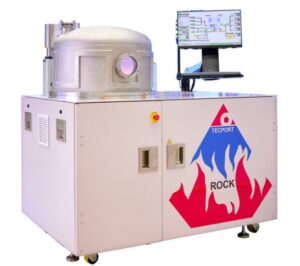
While a large variety of DLC deposition processes have been developed over many decades, production systems are rare. The advantages that DLC coatings offer, as described above, are available from Tecport Optics as a production-ready system. Manufacturing process control and temporal stability as well as distribution uniformity are insured.
Tecport Optics designs and supports custom thin film vacuum deposition solutions, including Diamond-Like Carbon coating systems, along with subsystem upgrades and process-focused services that help teams move from development runs to stable production.
Ready to upgrade your defense optics? Let’s connect and discuss practical next steps focused around your substrates, target bands, and environmental requirements.