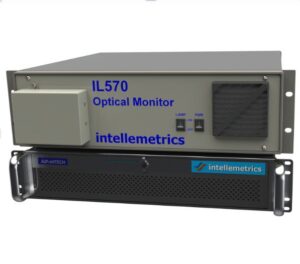
Optical monitoring is the in-process measurement technique that tracks the optical thickness of each growing film in real time, giving engineers the feedback they need to control the accuracy required.
How Optical Monitoring Works
An optical monitoring system (OMS) measures the optical thickness of a growing film layer during deposition. It does this by detecting interference effects as light passes through the film on a test glass or witness substrate inside the chamber. Measurement of optical thickness, composed of the physical thickness of the film and its refractive index, is more accurate and complete than physical-thickness measurement alone.
The two main approaches are monochromatic and broadband monitoring. Monochromatic systems use a single wavelength and are the simplest to implement. For each layer, a monochromator or a set of narrow band filters is used to select the wavelength that undergoes multiple quarter-wave optical thickness variations as that layer is deposited.
OM finds its best application in visible and near-IR wavelengths where light sources, detectors, and glass optics and chamber windows are readily available. The technique is not usable for thin layers, such as UV designs, where layer thickness does not provide an inflection point in wavelength vs thickness. Thickness monitoring outside the visible-NIR range is typically done using Quartz crystal microbalance (QCM). Optical monitoring at UV and IR wavelengths requires special optics, sources, and detectors.
Optical monitoring can be done either in reflection or transmission mode, depending on the coating materials and substrate, and whether they are dielectric or metallic.
Broadband systems cover simultaneously a wide spectral range in which multiple QWs are present in the spectrum. Its strength is the inclusion of the wavelength dispersion of refractive index. A white light source and CCD array form the basic components.
As with single-wavelength monitoring, the real-time signal can be used through computer control to terminate layer optical thickness and apply any required corrections with high accuracy and precision. A computer-based program compares the signal measured with the predicted reflectance or transmittance and generates a signal for deposition rate control. Often, OM is used in conjunction with crystal monitoring.
Why Real-Time Feedback Matters
Coating processes rarely proceed with smooth consistency. Deposition rates shift, and chamber conditions such as temperature and pressure evolve over time. A system relying only on time or crystal-based control cannot respond to those changes mid-run.
Real-time OMS feedback changes this. The key advantages include:
- In-situ correction. Errors in the optical thickness of a layer can propagate through a multilayer stack. Optical monitoring permits self-correction, adjusting the cut point for each subsequent layer based on what was actually deposited as compared to the prescription.
- Faster process qualification. Because the system logs spectral data for every layer, engineers can diagnose and correct issues, thus requiring less iteration time between runs.
Optical Monitoring vs. Crystal Monitoring
Quartz crystal microbalance (QCM) monitoring is a well-established, high-sensitivity technique for tracking physical thickness corresponding to mass accumulation during deposition. It is fast, robust, and compatible with most automated systems. Distributed QCMs and multiple head crystal units are used to sample and ensure evenly distributed thickness.
| Attribute / Technique | Crystal (QCM) | Optical Monitoring |
|---|---|---|
| Measures | Physical thickness | Optical thickness (n × t) |
| Self-correction | No | Yes |
| Deposited rate control | Yes | No |
| Sensitive to optical thickness | No | Yes |
| Best application | UV and IR designs | Visible – near IR wavelengths |
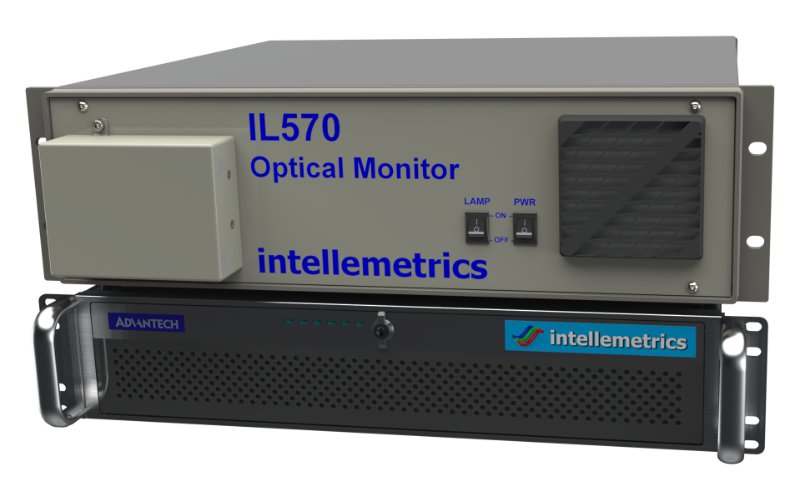
For the most demanding optical specifications, the two methods are most effective when used together. QCM handles rate control, while OMS handles layer termination and spectral verification.
Placement and Integration in the Chamber
The value of an OMS depends not just on the hardware, but on how it is integrated into the chamber. Sensor placement is critical. A monitor that does not see the same flux distribution as the substrate will generate data that does not match the part.
Effective integration involves several factors:
- Positioning the test glass or witness sample where the flux closely matches the substrate zone.
- Synchronizing measurements with substrate rotation to allow direct on-part monitoring in some configurations.
- Programming the OMS output to the deposition controller so layer termination is automated and deterministic
- Using software that logs full spectral data and supports recipe-based process control for run-to-run consistency.
Chamber tooling, uniformity mask design, and source-to-substrate geometry affect how well the OMS signal represents the actual film. Getting these parameters right during system design is as important as the monitor hardware itself. Often, correction factors, known as “tooling factors”, are needed to match the monitor witness to the actual production parts.
Build Your Next System Around Precision
Precision in thin film deposition is intimately dependent on accurate layer-by-layer monitoring. Are your multilayer stacks suffering from layer-to-layer variation? Relying only on crystal monitoring leaves room for error.
See how Optical Monitoring Systems (OMS) provide the critical real-time, self-correcting feedback you need to hit specifications every single run. OMS tracks optical thickness (n x t) and refractive index live, ensuring tighter layer termination for precision multilayer stacks.
Stop iterating and start delivering. Learn how to integrate OMS effectively. Connect with Tecport Optics to discuss a system engineered around your precision targets.