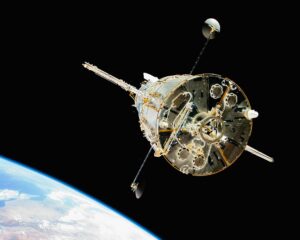
Space missions push scientific hardware to its absolute limits, operating in environments defined by severe thermal swings, high vacuum, relentless micrometeorite and particulate impact and electromagnetic radiation. Optical coatings must maintain their optical and durability performance, often for many years of service.
As missions venture farther into the solar system, meeting the rigorous demands of deep space requires coatings with superior environmental stability, zero outgassing, and exceptional adhesion.
The Extreme Demands of the Space Environment
Operation in near-earth and in deep space environments introduces a unique set of challenges. Exposed instrument surfaces are constantly bombarded by solar proton events, galactic cosmic rays, ultraviolet radiation and energetic particles.
Over time, these conditions can degrade reflectance and transmission properties on optics that lack adequate durability. Because there is no possibility for part replacement or routine maintenance following deployment, these components must endure independently.
The presence of a hard vacuum introduces additional difficulties. The absence of atmospheric pressure causes specific materials to outgas, which can contaminate neighboring optical parts. Consequently, protective films are required to possess low outgassing characteristics.
Furthermore, thermal cycling subjects hardware to rapid transitions between extreme solar heat and profound shadow cold. Any film that experiences delamination or cracking under these thermal shifts will compromise the utility of the entire optical system.
How Optical Coatings Handle High-Energy Radiation
Radiation is among the most destructive forces a space-bound optical system faces. High-energy photons and charged particles interact with film constituents at the atomic level. They create color centers, alter refractive indices, and cause absorption increases in compounds that were once highly transparent.
Material selection and deposition process are critical ingredients for producing space environment stability. Oxides such as silicon dioxide and hafnium oxide are widely chosen for their radiation hardness.
Fluoride compounds offer strong UV transmission but require careful deposition control to preserve their composition. The layering sequence, total physical thickness, and interface quality all influence how a coating responds to accumulated radiation dose.
Deposition technique matters as much as composition. Coatings must be dense, adherent films with low defect density and low contamination to resist radiation damage. High-energy processes such as Ion-assisted and plasma ion assisted deposition techniques produce this kind of film quality. They are thus a preferred approach for space-grade optical components.
Considerations for Space Vacuum-Compatible Optical Coatings
The optical and durability properties of a coated optic are determined by the deposition process and procedure. Precise process control, steady plasma conditions, and consistent chamber operating parameters as well as thorough testing and qualification to MIL Standards are fundamental requirements.

Key factors engineers evaluate for vacuum-compatible space coatings include:
- Outgassing rate: Films must meet strict cleanliness standards for spacecraft integration. High outgassing contaminates nearby optics and reduces overall throughput.
- Adhesion strength: Coatings must withstand launch vibration and thermal cycling without delamination or microcracking.
- Spectral stability: The coating's reflectance or transmission profile must remain consistent across the operating temperature range. It must also hold steady over the full mission lifetime.
- Surface roughness: Scatter from uneven interfaces reduces system throughput. Smooth, well-controlled film growth is essential for high-fidelity imaging.
Each of these characteristics is shaped by the deposition system's capabilities. Precise process control, steady plasma conditions, and repeatable chamber performance are fundamental requirements.
Coating Technologies Used in Space Instrumentation
Several deposition methods suit space-grade optical coatings well. Each offers distinct advantages depending on the application.
Ion Beam Sputtering (IBS) is the gold standard for precision space optics. It produces extremely dense, smooth films with low scatter and tight spectral tolerances. Gravitational wave detectors and space telescope mirrors rely on IBS for this reason.
Plasma Assisted Deposition (PAD) combines the high throughput of evaporation with enhanced film density from energetic ion bombardment. This method fits well when manufacturers must achieve both high production volume and excellent coating quality. PAD platforms offer flexibility across a wide range of film chemistries.
E-beam deposition remains a foundational approach for many optical applications. When paired with ion assistance, E-B delivers films with improved packing density and adhesion compared to resistance-heated evaporation.
The right choice between these methods depends on a mission's spectral requirements, qualification standards, and volume targets.
Build Your Space-Grade Coating Process on the Right Foundation
Your coating's performance is only as consistent as the system producing it. A platform that drifts in process parameters creates film variability. In space instrumentation, that variability is unacceptable.
If your program requires stable, repeatable coatings at the component level, the deposition equipment behind those films matters. At Tecport Optics, we design and manufacture vacuum deposition platforms engineered for this kind of precision work. Our systems support IBS, PAD, and related processes used in satellite and defense optics production.
We configure every system to meet your specific process and volume requirements. You receive a fully tested, production-ready platform from day one. When every photon counts, process confidence is not a luxury; it is a necessity. Contact our team to discuss how we can support your next space instrumentation program.
FAQ
What role do ultra-black coatings play in deep space instruments?
Ultra-black coatings are critical for stray light suppression in sensitive instruments like star trackers and space telescopes. They are applied to internal baffles and vanes to trap unwanted photons effectively, often utilizing a specialized low reflectance coating with a fractal-like surface structure to minimize reflection regardless of the angle of incidence.
Beyond resisting thermal cycling, how do coatings perform a thermal role in space?
In the vacuum of space, coatings play a dual optical and thermal role by managing heat transfer, which primarily occurs through radiation. A key performance indicator for coating selection is the alpha/epsilon (α/ε) ratio, which compares solar absorptance (α) (how much incoming solar radiation is absorbed) to thermal emittance (ε) (how effectively the surface radiates heat to space). Coatings with high thermal emissivity are used to efficiently dissipate heat.
Why is "space heritage" a key factor when selecting coatings for a mission?
Space heritage and qualification are critical for risk reduction. Since there is no opportunity for maintenance once an instrument is deployed, engineers prefer solutions that have already been qualified by agencies like ESA or NASA and have a proven track record on operational satellites. This offers a level of assurance that new, untested materials cannot.