Aerospace and defense optical systems deployed on airborne, maritime, and ground platforms routinely operate far outside controlled laboratory environments. High-speed particulate impacts, rain erosion, salt spray, and aggressive thermal cycling present continuous mechanical and chemical threats to exposed optical elements. Incorporating a DLC coating onto infrared (IR) windows provides a vital protective layer, pairing diamond-like mechanical hardness with advantageous spectral performance in the IR spectrum.
As operational envelopes expand, modern deposition control technologies are pushing the performance boundaries of these films to safeguard critical optical sensors.
Environmental Stressors on Tactical Optics
Field conditions degrade optical surfaces through mechanisms that standard thin-film coatings can’t survive. A germanium or silicon window mounted on a low-flying aircraft or tank operating in a desert theater can experience eroding sand, dust and water drop particles. Each micro-impact chips away at the optical surface, generating micro-fractures that rapidly increase scatter, elevate haze, and reduce in-band optical throughput.
Standard oxide and fluoride dielectric thin films offer exceptional antireflection characteristics, but their low mechanical hardness makes them vulnerable to field degradation. Scratches from cleaning with contaminated field equipment, rain droplet impingement at high velocity, and corrosive salt fog quickly degrade conventionally-coated optical surfaces.
To mitigate these failure modes, program specifications increasingly mandate rigorous testing to established MIL-SPEC and ISO standards, demanding verified resistance against severe abrasion, as well as adhesion loss, humidity degradation, and thermal shock.
DLC Layers Offer Mechanical Advantages
The exceptional mechanical durability of a DLC coating stems from its amorphous carbon diamond-like structure, which contains a high fraction of tetrahedrally bonded sp³ carbon atoms structurally analogous to natural diamond. Depending on process parameters, hydrogenated amorphous carbon films achieve hardness values between 10 and 25 GPa.
Hardness alone, however, does not guarantee survivability. An additional mechanical advantage of DLC layers is their low coefficient of sliding friction that resists scouring wear by impacting abrasive particles.
High internal compressive stress within carbon films can cause delamination on thicker layers or under sudden mechanical shock.
A few process components incorporated in optimized DLC layers are:
- Graded Interlayer Transitioning. Intermediate layers composed of silicon- or germanium-based compounds are deposited prior to the carbon film. These materials form strong bonds with carbon and can be used as interlayers to transition between differences in thermal expansion coefficients and elastic moduli between the substrate and optical coating, yielding exceptional adhesion strength.
- Compressive Stress Management. DLC layers have high compressive stress. Precise modulation of substrate bias voltage and chamber pressure is used to control intrinsic film stress within a stable operating window, permitting thicker growth without film peeling.
- Surface Interface Decontamination. High-energy plasma pre-cleaning removes organic residues and oxide layers, eliminating defect nucleation sites such as pinholes and nodules.
Optical Integration and Infrared Transparency
Beyond physical ruggedization, integrating a DLC coating offers distinct optical advantages for infrared sensor windows. In the long-wave infrared (LWIR) band spanning 8 to 12 microns, the refractive index of amorphous carbon sits near 2.0. When applied to high-index substrates like germanium (n ≈ 4.0), this film fulfills the mathematical ideal for a single-layer antireflection coating (ⁿ film = √ⁿsubstrate). Consequently, a single deposited layer simultaneously serves as an environmental protective barrier and an antireflective property enhancer.
For mid-wave infrared (MWIR) applications operating in the 3 to 5 micron region, chemical composition requires tighter control. Carbon-hydrogen (C – H) molecular bonds introduce characteristic absorption bands near 3.4 microns. Reducing hydrogen precursor concentration during deposition minimizes this absorption feature, maintaining high spectral transmission across the MWIR band.
Engineers optimizing protective optical windows utilize several core design tactics:
- Quarter-Wave Thickness Matching. Tuning layer thickness to center the optical destructive interference condition precisely within the system operating band.
- Hydrogen Fraction Control. Adjusting process gas stoichiometry and ion bombarding energy to suppress unwanted absorption features in targeted MWIR bands.
- Asymmetric Surface Coating Strategies. Applying a durable DLC coating to the exposed outer surface while deploying a high-efficiency multi-layer dielectric antireflection stack on the protected internal surface to maximize overall throughput.
Deposition Systems and Process Control Solutions by Tecport Optics
Achieving consistent film properties across production batches has driven major advances in deposition equipment. Plasma-Enhanced Chemical Vapor Deposition (PECVD) remains the dominant methodology for hydrogenated amorphous DLC films, while ion-beam sputtering and filtered cathodic vacuum arc methods are deployed when higher sp³ content is mandatory.
Contemporary coating hardware relies on closed-loop automation to maintain rigorous control over process variables. Real-time feedback monitoring of RF bias power, gas mass flow rates, and dynamic chamber pressure prevents process drift over extended deposition cycles. Automated recipe execution eliminates operator-induced variance, guaranteeing that stress states, optical constants, and mechanical hardness metrics remain identical from batch to batch.
Solutions by Tecport Optics
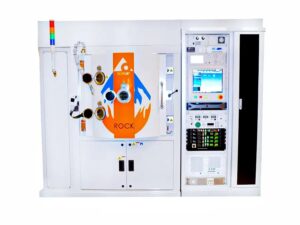
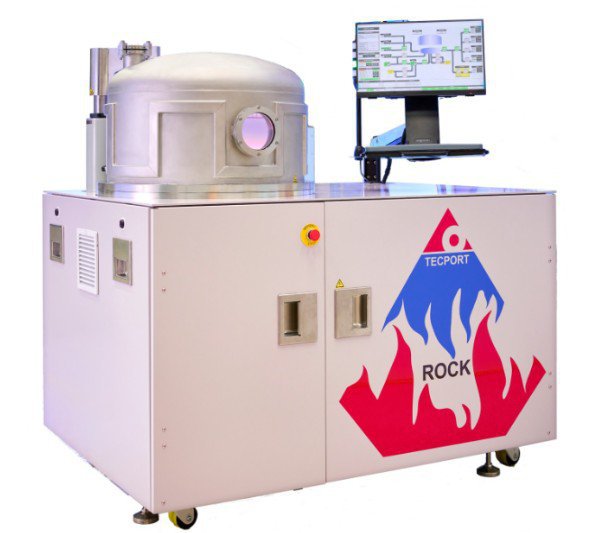
Scaling high-performance carbon processes from development labs to full production demands purpose-built deposition systems. Tecport Optics engineers industrial-grade coating equipment designed specifically for processing durable carbon films onto challenging infrared substrates and geometries. The Tecport Optics Rock DLC deposition system incorporates customized chamber architectures, specialized fixturing, and optimized plasma sources tailored to precise component shapes and throughput requirements.
To streamline implementation, we deliver complete process-ready packages alongside hardware installations. Our engineering team works directly with you to develop and validate custom deposition recipes, ensuring target hardness, internal stress parameters, and spectral transmission curves are achieved on production parts. Let’s connect to review your substrate requirements, spectral targets, and operational constraints.