
When light transitions between media with differing refractive indices, a predictable percentage of incident energy is lost to reflection; approximately 4% per surface for standard glass (1.52 for BK-7 at visible wavelengths), but as much as 36% for germanium optics. Consumer prescription eyewear is routinely AR coated to reduce glare for the user. In critical optical systems such as imagers, minimizing Fresnel reflection at material surfaces is required to maximize performance. Across multi-element assemblies, these losses compound, reducing throughput and contrast and generating glare and ghost images, and risking catastrophic back-reflection damage in high-power laser applications. A properly designed and deposited anti-reflective coating reduces these degrading effects.
Optimizing Refractive Index for Anti-Reflective Coating
Light propagates as a wave. When incident light strikes a coated optical surface, the interaction generates two distinct reflections: one from the outer surface of the coating and another from the substrate interface beneath it. An AR coating functions to produce an out of phase relationship between the internal reflections thereby causing them to cancel.
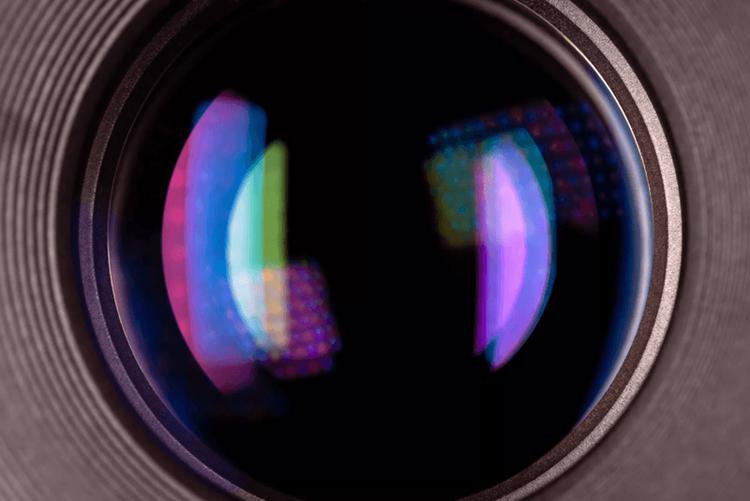
This effect dramatically reduces surface reflectance. While a single-layer coating can theoretically achieve zero reflectance at a design wavelength, wide-band AR coatings are employed to reduce the average reflection over a span of wavelengths and are multilayer designs. Commercial and scientific camera lenses and IR imagers require wide-band AR coatings (WBARC)
Selecting Coating Materials for Anti-Reflective Coating
The refractive index of a narrow-band AR coating must equal the square-root of the substrate's refractive index and its optical thickness a quarter wave. In this design reflectance can equal zero at one wavelength point.
For glass substrates, magnesium fluoride (MgF2) or silicon dioxide (SiO2) are typically used due to refractive index approximating the square-root of glass index. For infrared substrates with high refractive indices, such as germanium or silicon, single-layer materials like ZnS, ZnSe and diamond-like carbon (DLC) serve as effective narrow-band AR coatings.
Single-Layer vs. Multi-Layer AR Coatings
Single-layer coatings provide a cost-effective solution for narrowband or monochromatic applications, such as single-wavelength laser systems. They are typically thicker than the component layers of a multi-layer AR.
Wide-band AR coatings employ multi-layer designs composed of alternating high-index and low-index layers. Consumer eyewear lenses are coated with a 5-layer wideband design of oxide compounds to eliminate visual glare from the scene.
Multi-layer coatings stack multiple thin films with precise thicknesses and refractive indices. Each interface facilitates additional destructive interference, extending performance across a wider spectral range.
Multi-layer designs frequently achieve reflectance levels below 1 to 0.5% over a broad bandwidth, making them the preferred choice for broadband multi-wavelength systems.
In multi-lens optical systems, multi-layer coatings are essential to control the accumulation of Fresnel reflections, which can otherwise degrade throughput, suppress contrast, and introduce ghost images that destabilize laser cavities.
Determining Performance Requirements
Not every application necessitates a complex multi-layer stack. While a single-layer coating may suffice for a narrowband filter or fixed-wavelength sensor, multi-layer coatings are necessary under the following conditions where ghost images and stray light must be suppressed to meet stringent contrast and target-detection criteria:
- The system operates across a broad spectral range (e.g., visible through near-infrared or IR passbands).
- Multiple transmitting elements are present, causing accumulated reflection losses.
- Low light level imaging, airborne electro-optical systems, or high-power lasers.
- High-energy laser optics where high laser damage thresholds are required.
In defense and aerospace optics, these conditions often occur simultaneously, necessitating the high performance of multi-layer AR coatings.
Deposition Technology and Precision
AR coating performance relies heavily on deposition precision. Film thickness must be controlled within a few nanometers, and refractive index must remain consistent through all layers. These requirements necessitate advanced deposition systems with rigorous process controls.
Ion Beam Sputtering (IBS) and, Plasma-Assisted Deposition (PAD) produce extremely dense, low-scatter films with exceptional thickness accuracy and high laser damage thresholds. Both methods are vital for demanding AR applications where spectral tolerances are tight.
Engineered AR Solutions
When your optical system requires precise, repeatable AR performance, the deposition platform is as critical as the design itself. At Tecport Optics, we engineer custom thin film deposition systems that are built around your specific process requirements.
Whether you need a high-throughput PVD system for single-layer coatings or a sophisticated IBS or PAD platform for complex multi-layer AR stacks, we can configure a production-ready system tailored to your spectral targets and volume needs. Reach out to us to discuss what your coating process demands.