Precision optical systems deployed on an airborne sensor or other critical applications require optical coatings with high environmental stability. A coating that shifts with humidity or temperature can degrade performance. Optical coatings produced with Ion-Assisted Deposition (IAD), a specialized thin film deposition technique, address this challenge directly, offering a path to fully densified, zero-shift thin films that maintain spectral performance across real-world conditions.
Why Spectral Shift Is a Problem in Optical Coatings
Conventional evaporative deposition produces porous film structures. The resulting films absorb moisture from the ambient environment, which changes their refractive index. That change causes a reversible shift in the coating's spectral response as the humid/arid environment changes.
This effect is especially critical in bandpass filters, anti-reflection coatings, and high-reflector mirrors. Even small shifts in center or edge wavelengths can degrade system performance. The combination of humidity and temperature variation can shift a coating's spectrum enough to push it outside its specification window. For applications in aerospace and defense, where sensors must perform within tight spectral tolerances, this instability is unacceptable.
How IAD Eliminates Porosity in Optical Coatings
IAD works by directing energetic ions at the growing film during deposition. High-energy Argon ions transfer momentum to the depositing atoms, increasing their mobility on the surface. This process disrupts the columnar microstructure that forms naturally during conventional evaporation.
The result is a denser, void-free film layer that is impervious to moisture penetration. The refractive index remains stable regardless of the humidity of the surrounding environment. The film also becomes harder and more abrasion resistant.
Key process variables that control densification include:
- Ion energy: IAD sources operate at ion energies around 100 eV to 150 eV to avoid crystallite formation.
- Ion beam current: Higher beam current density over larger substrate areas, and ensures uniform densification across the full coating zone.
- Gas selection: Densification and oxidation of oxide compounds are promoted by the addition of oxygen ions with the argon gas mixture.
Densification in Multilayer Coating Stacks
Different materials densify at different ion doses. Hafnia (Hafnium dioxide), for example, requires more than triple the ion dose needed for titania (Titanium Dioxide), tantala (Tantalum Pentoxide), or silica (Silicon Dioxide). IAD Ion energy and current density are optimized for each material.
IAD for Temperature-Sensitive Substrates
One of IAD's most valued properties in production is its ability to deliver fully dense films at low substrate temperatures. Traditional coating processes often rely on elevated substrate temperatures to promote adatom mobility and film density. That approach is incompatible with plastic optics, polymer films, and other heat-sensitive components.
IAD supplies the required energy through ion bombardment rather than thermal input. This means optical coatings with zero-shift performance can be deposited on substrates that would otherwise be damaged by heat.
Additional benefits of IAD at low temperature include:
- Faster production cycle times, since no substrate pre-heating or slow cool-down is required
- Broader substrate material compatibility, including glass, polymers, and sensitive crystals
- Improved adhesion on unheated substrates due to surface activation from the ion beam prior to deposition
Achieving Zero-Shift Performance With Precision Thin Film Deposition
Zero-shift performance is the result of a precisely engineered system that considers the ion source, chamber geometry, gas composition control, and rate and thickness monitoring parameters to produce the optimum coating process.
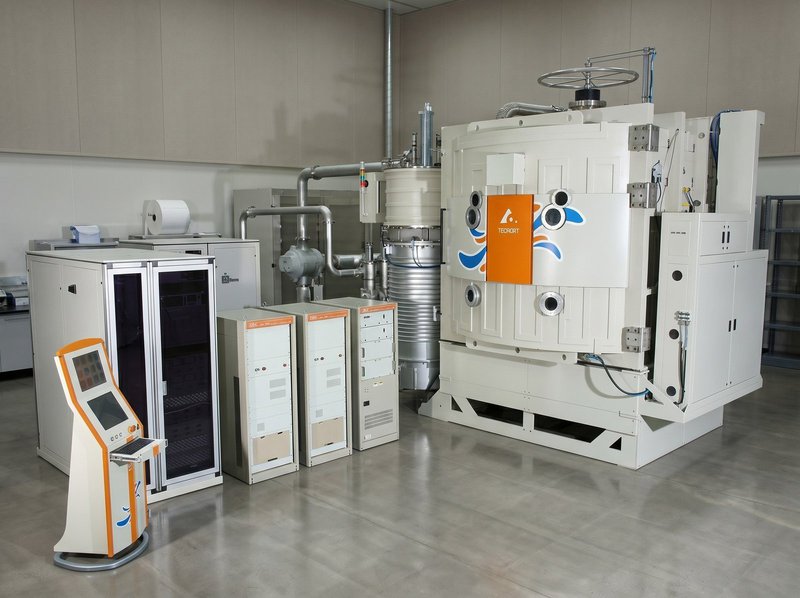
At Tecport Optics, we design and build IAD-capable vacuum coating systems tailored to your specific optical coating requirements. Our systems integrate ion sources with optimized placement and pointing for uniform ion flux across large substrate areas. We support process development from initial parameter selection through full production qualification, and our engineering team will work with you to achieve the stable, shift-free coatings your application demands.
If you are ready to take the next step toward zero-shift coatings, contact us to discuss how an IAD-equipped system can be configured for your production needs.