Moving thin film deposition from a lab tool to a production asset is less about “making it bigger” and more about engineering out variability. The systems that scale well are the ones designed around repeatable film outcomes, controlled material flow, and maintainable uptime from day one.
Thin Film Deposition: Where Scale-up Usually Breaks
R&D tools are optimized for flexibility: fast material swaps, open parameter space, and frequent human intervention. Production is the opposite: narrow process windows, high utilization, and predictable yields across many lots, shifts, and operators.
Common transition challenges from R&D to production often show up in places teams do not always instrument early. These include:
- Substrate handling drift. Part-to-part orientation changes, fixture wear, and loading patterns remain invisible during small R&D batches. These factors become critical sources of variation as batch sizes grow during the transition to production.
- Chamber condition sensitivity. Coating build-up, shield history, and maintenance cycles have minimal impact on small R&D runs but begin to drive significant process drift as chamber utilization increases during the scale-up phase.
- Metrology mismatch. A lab measurement method that correlates adequately in R&D may require refinement to track in-chamber endpoints as production volumes increase.
- Pumpdown and stabilization time. Extra minutes per cycle that were easily absorbed into R&D schedules become increasingly problematic during the transition as production targets require higher throughput and tighter cycle times.
- People-dependent recipes. Undocumented "tribal knowledge" steps work fine with a small R&D team. However, with volume increase, multiple shifts, and new operators, process standardization is key to executing the work reliably.
The takeaway is straightforward. Scaling problems rarely come from a single knob. They come from weak coupling between design, controls, and verification.
Maintaining Thin Film Deposition Repeatability at Higher Volumes
As volumes rise, the goal shifts from “can we hit the spec once” to “can we hit the spec every run without heroics.” Run-to-run consistency depends on controlling the variables that actually move film properties. It can include deposition rate, energy at the growing film, temperature, and background contamination.
In-situ monitoring is a key piece of that control loop. Quartz crystal monitoring (QCM) works by tracking a crystal’s resonant frequency drop as deposited mass increases, converting that signal into rate and thickness in real time.
When throughput increases or coating geometry becomes more complex, multi-sensor strategies and correlation to witness coupons help keep thickness control aligned to the parts, not just a single point in the chamber.
Repeatability also depends on operational discipline, which production teams sometimes postpone until “after ramp.” This includes calibrated tooling factors, documented shield change criteria, and structured maintenance intervals tied to film drift trends rather than calendar time.

Automation and Process Control Integration
Higher volume exposes every manual step as a variability amplifier. Automation is not just robotics or push-button operation. It is the combination of recipe governance, interlocks, data capture, and consistent sequencing so the process runs the same way at 2 PM and 2 AM.
A practical automation scope for scale-up usually includes:
- Recipe management and access control. Locked production recipes with controlled editing rights ensure that process changes are traceable through version control and maintain consistency across all production runs.
- End-to-end sequencing. Automated pumpdown, valve states, gas flow control, source conditioning, deposition steps, and shutdown eliminate manual timing variations and guarantee repeatable cycle execution every run.
- Interlocks and permissives. Safety and equipment-protection logic prevents "almost OK" starts and protects both personnel and equipment. Interlocks ensure that only valid process conditions are allowed to proceed.
- Data logging and trending. Time series records for pressure, power, rate, temperature, and endpoints enable early detection of process drift before it causes failures or yield loss.
This is also where time-to-production is won or lost. A scalable control architecture makes it easier to add sensors, swap sources, or expand to additional layers without rewriting the entire control stack.
Designing the Chamber for Scalable Throughput
Chamber design decisions set the ceiling on capacity and the floor on variability. Scaling typically requires revisiting geometry, fixturing, pumping, and thermal management. This is so that the process window is not “knife-edge” sensitive to loading and chamber history.
Key design principles that support growth include:
- Fixturing designed for uniformity under load. Dome or planetary rotation schemes can help maintain uniform angular exposure across a larger part count.
- Pumping and conductance designed for cycle time. Stable base pressure and rapid recovery between steps reduce both defects and takt time.
- Shielding and service access. Components that are easy to clean and replace help keep chamber condition consistent across long runs.
- Thermal control that matches the film stack. Heater zoning and temperature sensing that maintain the same substrate thermal profile across batch positions.
Custom chamber design for scalability is not customization for its own sake; it is the structured alignment of chamber volume, source placement, fixture motion, and pumping path to your expected part mix and growth plan.
Turning Scale-up Into a Production Roadmap
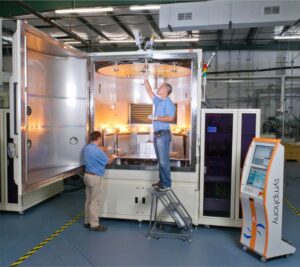
If you are planning the jump from pilot to production, a useful next step is a system-level design review that ties together chamber architecture, monitoring, and automation around the film requirements and expected throughput. Tecport Optics builds custom vacuum coating platforms such as the Symphony Precision. It combines crystal and optical monitoring with OPUS software capabilities like data logging, recipe tools, reporting, and remote access for production control.
Tecport also supports automation retrofits and upgrades for existing coaters, including modular integration of subsystems, preprogrammed safety interlocks, and extensive data logging and analysis features intended for reliable operation at scale.
If accelerating time-to-production is a priority, start a technical conversation with Tecport Optics about the process goals, volume targets, and facility constraints so the equipment and controls can be engineered for the ramp you actually need.