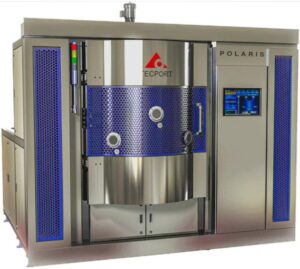
When critical coating requirements include complex geometries, substrate thermal limitations, and low stress, Plasma-Enhanced Chemical Vapor Deposition (PECVD) satisfies these requirements better than PVD processes. Coatings suitable for optical, military, industrial and commercial industries are produced using PECVD.
Fundamentals of PECVD for Coating Equipment
PECVD is a CVD variant where an energetic plasma supplies a portion of the reaction energy. This permits film formation at significantly lower substrate temperatures than thermal CVD.
In a typical PECVD reactor, specific precursor gases are decomposed by RF power that sustains a glow discharge plasma between electrodes. Reactive species are created that are involved in and responsible for surface reactions and film growth. Composition control involving hydrogen incorporation is a parameter that influences transparency and stress for some film materials such as DLC. Control of gas flow rate, pressure and composition and pumping capacity parameters is employed. Undesired by-products of the reaction are continuously removed to provide a stable deposition rate of consistent composition stoichiometry.
Key process parameters that define PECVD results include:
- Gas chemistry and relative flow ratios, since the plasma decomposes and activates precursor molecules and shifts film stoichiometry.
- Pressure and RF power, since both influence ion energy, radical density, and the balance between surface reactions and gas-phase reactions.
- Temperature, since PECVD can operate from room temperature up to a few hundred °F.
“Cold Plasma” PECVD Process Enables Deposition on Heat-Sensitive Substrates
A significant advantage of PECVD is the ability to grow film layers at temperatures approaching room temperature, thus enabling the coating of polymers and other temperature-sensitive materials.
Thickness Conformity on Complex Surfaces
A second advantage of PECVD is its natural uniform thickness conformity over complex geometric shapes. Unlike the line-of-site property of PVD, deep topographic features, such as trench sidewalls, and shadowed regions can be coated. Uniform coating on domed optics is a common application.

Stress Control
Film stress control is often the deciding factor for optical stacks and functional layers, because stress drives bending curvature, birefringence, adhesion risk, and long-term stability. PECVD gives engineers multiple stress levers through chemistry and plasma conditions. Residual stress in films such as silicon nitride is strongly tied to hydrogen content. This, in turn, depends on temperature, pressure, and plasma conditions.
Comparing PECVD, PAD, and IBS
Comparing PECVD to two common physical-vacuum alternatives helps clarify selection:
- PAD (plasma-assisted deposition) is frequently applied to improve adhesion and optical properties compared with unassisted evaporation. It uses a high-density plasma source to increase ionization and energy delivered to the growing film.
- IBS (ion beam sputtering) is widely used when the specification demands very dense, low-loss films and tight repeatability. It is supported by independent control of ion-related variables and process precision that favors high-performance optics.
Ion-assist concepts also highlight why “energy at the surface” matters for stress. Published ion-assist discussions describe tensile stress in vapor-deposited metal films deposited near room temperature. It showed that ion bombardment at low energies (on the order of ≤100 eV) can reduce that tensile stress, demonstrating a practical route to stress tuning without relying solely on substrate heating. The same principle is applicable to controlling the intrinsic stress in dielectric layers.
Scaling PECVD
Transitioning and scaling PECVD processes from development to production involves consideration that include achieving uniform distribution over large areas (multiple surfaces) and high part thruput rate.
A practical scale-up checklist looks like this:
- Insure uniform plasma density across the substrate load, since nonuniform ion and radical distributions translate into thickness and property drift across fixtures.
- Insure stable gas delivery and pressure control, since PECVD film properties are highly sensitive to chemistry and pressure operating points.
- Manage pumping configuration and byproduct exhaust, since PECVD continuously generates reaction byproducts that must be removed by the pumping system.
- Throughput strategy (batch size, cycle time, and qualification plan), since PECVD is often selected because it can maintain good film quality at relatively fast rates compared with high-temperature CVD options.
PECVD Coating Equipment: The Path Forward
PECVD coating equipment has evolved beyond niche applications into a critical enabler for modern optics manufacturing. When thermal budgets tighten, geometry demands conformality, or stress control drives performance, plasma-enhanced processes deliver measurable advantages over conventional alternatives.
The key is matching the deposition process to the intended application. PECVD's low-temperature advantage, conformal coverage and tunable film properties provides unique solutions to challenges in aerospace optics, sensor assemblies, and other demanding coatings.
Tecport Optics' cold plasma technology solutions address these exact challenges. Our proven approach to stress control, film quality, and equipment repeatability makes PECVD a practical choice for high-performance optical systems. Ready to optimize your coating equipment strategy? Let’s connect.