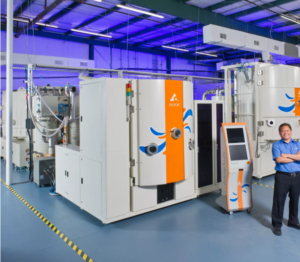
Defense and aerospace optics fail in predictable ways: adhesion loss at interfaces, density-driven moisture uptake, and scatter from surface and bulk defects. PVD is widely used for optical coating because it can combine high-purity deposition with energetic assistance that improves packing density and adhesion when process conditions are controlled.
How PVD Improves Adhesion, Density, and Uniformity
PVD is a family of vacuum processes that includes evaporation, sputtering, and ion-assisted techniques. CVD, in contrast, relies on precursor gases that react chemically to form films. PVD physically transfers material from a source to a substrate. The key performance factor is applying higher energy to the deposition process itself.
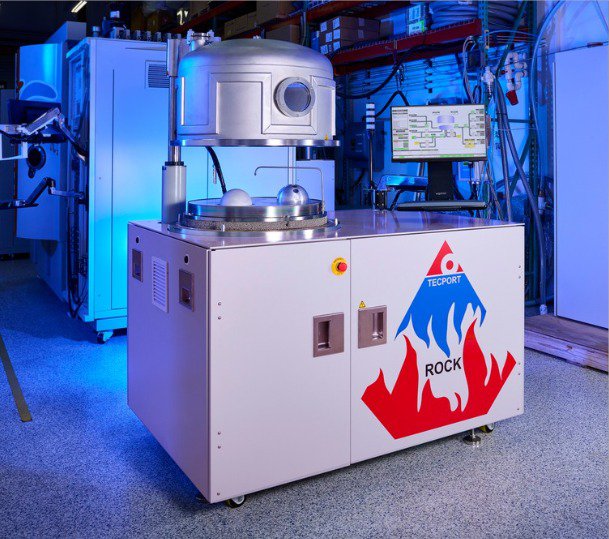
Adhesion and density improve when the growing film receives additional energy, commonly through ion bombardment (ion-assisted deposition, ion plating, or ion beam-assisted deposition), which promotes densification and can enhance interfacial bonding.
Several mechanisms are routinely leveraged in high-durability optical stacks:
- Ion-Assisted Growth increases film density and enhances adhesion. It also improves hardness, wear resistance, and stoichiometry control in multilayer optical systems.
- Ion Pre-Cleaning removes physisorbed contamination such as water and hydrocarbons from the substrate surface. Clean surface conditions directly improve adhesion performance. This step is distinct from ion-assisted deposition (IAD) and should not be conflated with it.
- Controlled Energetic Particles in the tens of eV range are favored in ion and plasma PVD variants. At these energy levels, adatoms gain sufficient mobility to form dense, well-adhered films without causing surface damage. This energy window is particularly effective for producing environmentally stable dielectric multilayers.
Uniformity in PVD is not automatic because most PVD geometries are line-of-sight, so thickness control depends heavily on part motion, tooling factors, and fixture design. Practical uniformity improvements often come from engineered substrate rotation or planetary motion, stable deposition rates, and geometry that reduces shadowing on complex parts.
PVD vs. CVD for Defense and Aerospace Optical Coating
PVD and CVD can both produce dense, durable films, but they behave differently in production constraints that matter to defense and aerospace programs. CVD is non-line-of-sight and can deposit uniformly over substantial contours, which is valuable for complex shapes and recessed features. Many CVD approaches require high substrate heating. These temperatures can be incompatible with temperature-sensitive substrates, adhesives, or previously bonded assemblies common in optical hardware.
PVD processes typically operate with lower thermal load on substrates. This advantage matters when thermal budgets are tight. Dimensional stability becomes critical in precision optical systems. The trade-off is that line-of-sight deposition makes fixturing and chamber geometry central to uniformity. In practice, many defense and aerospace coating engineers use PVD when they want tight spectral control with low thermal risk, then add energetic assistance (ions or plasma) to close the durability gap that older "soft" evaporated films sometimes showed.
Reducing Defects Through PVD Process Optimization
Defects drive both optical loss and premature field failures, so yield improvement usually starts with identifying which defect class dominates. Pinholes, porosity, nodules, and non-uniform thickness are commonly cited PVD defect modes, with frequent root causes including poor cleaning, outgassing, particle contamination, and shadowing or motion issues.
Two themes consistently reduce defect-related scrap rejection: contamination control and energy management.
Contamination control includes chamber hygiene and mitigation of fixture flaking. Particle control prevents nodular growth that degrades optical performance. Energy management ensures adequate adatom mobility and ion assistance. This prevents open columnar microstructures that reduce density and durability.

Optimization levers that tend to be high impact in production include:
- Substrate preparation and in-chamber plasma or ion cleaning to reduce adsorbed contamination before deposition.
- Ion assistance during deposition to densify films, improve morphology, and strengthen adhesion, with dose and energy selected to avoid damage while achieving compaction.
- Motion and tooling optimization (rotation, planetary motion, part orientation) to reduce thickness non-uniformity and shadowing-related spectral drift.
- Monitoring and control practices that keep rate and process conditions stable, which helps avoid thickness excursions that show up as band shifts in optical performance.
Integrating High-Density PVD Into Existing Optical Coating Lines
Many facilities already have baseline evaporation or sputtering capability, so integration is often about upgrading "energy and control" rather than replacing everything. Ion or plasma assistance can be added to strengthen adhesion and increase packing density, which is especially helpful when environmental stability is required across humidity, thermal cycling, and high-velocity particulate exposure scenarios.
Tecport Optics builds custom thin-film deposition systems across PVD and plasma-assisted approaches. They also support process development and improvement of existing coating processes and systems. Their high-density plasma technology is positioned to improve adhesion and reduce stress compared to conventional electron beam evaporation. It includes plasma pre-cleaning intended to remove oil residue and dust from substrates.
Move Toward Denser, More Durable Optical Coating
If your next program requires tighter durability margins, higher film density, or lower defect rates, a PVD system and process audit can quickly identify whether plasma assist, ion assist, fixturing changes, or chamber upgrades will deliver the most leverage.
Tecport Optics can scope, build, and support custom vacuum coating platforms, plus upgrades, retrofits, and training aimed at getting teams to production-ready operation fast. Send a message today.