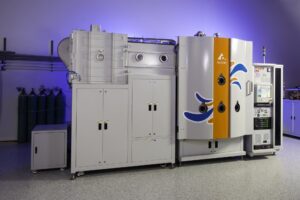
Production efficiency remains a primary challenge for high-precision defense and optical coating facilities, where inter-run downtime significantly impacts costs and total output. Optimizing cycle times while maintaining strict film integrity represents one of the most effective process enhancements an engineering department can implement for PVD coating equipment. This guide identifies specific areas where time is frequently lost and outlines strategies for recovery.
Identifying Time Losses in PVD Coating Workflows
A standard PVD production run involves several stages beyond the core deposition process. Each step adds to the total cycle duration. Recognizing where these minutes are spent is essential for mitigating bottlenecks that can arise even under modest production loads.
Typical time allocations for a sequential, unoptimized cycle include:
- Loading and Unloading: ~10 minutes each, depending on lot size
- Pump-down: ~30 minutes, depending on chamber condition
- Heat-up and Etching: ~30 minutes, depending on substrate limitations
- Deposition: 60 to 180 minutes, depending on coating design
- Cooling and Venting: up to 40 minutes
Actual values vary depending on chamber size, coating architecture, and production requirements.
Without strategic optimization, these cumulative phases can quickly become a significant constraint on throughput.
Improving Pumping Speed
The speed at which a vacuum chamber reaches process-ready pressure sets the pace for the production cycle. The pumping train consists of a roughing pump necessary to reach the low pressures that the high vacuum pump requires for operation. The pumping train is supported by pressure measurement and gas flow control in the case of reactive deposition processes that enable stable transitions from rough vacuum to high vacuum.
High vacuum pumping can be provided by cold-trapped oil diffusion pumps or cryo pumps. Cryogenic pumps offer exceptionally large pumping speeds for water and can evacuate large-volume chambers to ultra-high vacuum efficiently. Cryopumping is commonly used for infrared coating applications since it is essential for IR coating materials. However, cryopumps require periodic regeneration.
Partial regeneration takes approximately 40 minutes with modern microprocessor-controlled systems, compared to six hours for a full purge-gas cycle. Scheduling partial regenerations strategically, rather than running full cycles unnecessarily, keeps pump performance high while minimizing downtime.
Load-Lock Systems: A High-Impact Upgrade
One of the most effective functional changes to a PVD coating system is the addition of a load-lock chamber. Load-locks allow substrate transfer to occur while the main process chamber remains under vacuum. This means deposition runs the majority of the time without interruption from loading and pump-down.

In well-configured load-lock systems, cycle times can drop to as little as 1 to 5 minutes for certain applications. Key benefits of a load-lock configuration include:
- Uninterrupted vacuum integrity in the process chamber during substrate exchange
- Reduced contamination risk from atmospheric exposure
- Parallel processing, where pump-down in the load-lock occurs simultaneously with deposition in the main chamber
- Accurate pressure sensing at transfer points, which eliminates unnecessary delays between cycles
Precise pressure measurement at the point of wafer or substrate transfer is critical. Even a 5-second delay per load-lock cycle from inaccurate pressure sensing can have a significant cumulative impact on system throughput.
An important, often overlooked, step is to control a low rate of venting to atmospheric pressure to avoid stirring up or dislodging particulates and flakes through turbulence.
Balancing PVD Coating Equipment Heating Protocols with Film Integrity
While often viewed as a static necessity, substrate heating is a tunable process parameter. Elevating substrate temperatures during the deposition phase boosts atomic mobility, enabling atoms to reach lower-energy states and dense structural packing. High temperatures contribute to optimizing optical and mechanical properties. Conversely, inappropriate heating rates or excessive temperatures may create thermal stress.
To ensure consistency, a controlled, staged ramp-up is preferable to abrupt temperature shifts. Implementing a stabilization pause at a mid-range temperature allows the substrate and its fixtures to achieve thermal equilibrium without gradients. This practice ensures a uniform surface environment before the deposition cycle commences.
For multilayer or thick coatings, post-deposition thermal annealing offers an alternative. This controlled treatment uses atomic diffusion and grain growth to encourage stress relaxation, avoiding the delays associated with long in-chamber cooling periods.
Efficient Cooldown Strategies
Although it is often the longest stage following deposition, cool-down rate is critical; rushing this phase introduces potential thermal mismatch strain between the substrate and the deposited film.
Varying thermal expansion coefficients cause materials to cool at unequal rates, creating residual stress that can lead to coating cracks or delamination. Attempting to accelerate the cooling rate, frequently results in failed runs. To safely decrease cool-down duration, consider the following approaches:
- Active Backside Gas Cooling. Utilizing argon or nitrogen to transfer heat away from the substrate more rapidly than standard radiation cooling.
- Mechanical Clamping. Integrating substrate clamping with back-gas cooling to successfully maintain stable peak temperatures.
- Programmed Cool-Down Curves. Establishing procedures that control temperature declines, ensuring they stay within the stress tolerance of the film and substrate.
- Calibrated Temperature Monitoring. Employing sensors for continuous tracking to ensure repeatable performance across all runs.
For multilayer or thick coatings, post-deposition thermal annealing offers an alternative. This controlled treatment uses atomic diffusion and grain growth to encourage stress relaxation, avoiding the delays associated with long in-chamber cooling periods.
Work With a System Built for Your Process
Cycle time reduction is not purely a hardware problem. It also requires process engineering, system integration, and the right controls infrastructure. Tecport Optics designs and builds custom PVD coating equipment tailored to the exact throughput and film quality requirements of each facility.
From pumping train selection and load-lock integration to process recipe development and substrate fixturing, our systems are engineered for production-ready performance. If your current coating line is losing time between runs, reach out to our team.